
As your business grows, so does the demand for quality design. From social media posts and sales presentations to website updates and marketing campaigns, visual content quickly becomes an essential part of daily operations. Yet hiring a full in-house creative team isn’t always practical. That’s why many businesses choose to outsource graphic designer services instead, gaining access to professional design support without the long-term overheads of a permanent hire.
Two outsourcing models stand out: hiring a part-time designer or engaging a designer for a specific project. Both offer distinct advantages, but the right choice depends on your workload, budget and long-term business goals. Understanding how each model works can help you invest in design support that delivers lasting value.
What Is a Part-Time Outsourced Designer?
A part time designer works with your business on an ongoing basis for a set number of hours each week or month. Rather than joining your organisation as a full-time employee, they become a dedicated extension of your team, providing regular creative support whenever it’s needed.
Because they work with your business consistently, they develop a deeper understanding of your brand, audience and design preferences. Over time, this familiarity often leads to faster turnaround times, fewer revisions and more cohesive visual communication.
Typical responsibilities include:
- Designing social media graphics
- Creating brochures, flyers and other marketing materials
- Updating website banners and visuals
- Designing presentations and sales collateral
- Producing digital advertisements
- Supporting ongoing branding initiatives
For businesses with recurring creative requirements, a part-time arrangement offers dependable support without the commitment of a full-time hire.
What Is a Project-Based Outsourced Designer?
A project-based designer is hired to complete a specific piece of work within an agreed scope, budget and timeline. Once the project is delivered, the engagement typically ends unless additional work is commissioned.
This model works well when your design requirements are clearly defined and unlikely to continue beyond the project’s completion.
Common examples include:
- Brand refreshes or complete rebranding projects
- Website redesigns
- Product launch campaigns
- Event collateral and exhibition materials
- Annual reports or company profiles
Some businesses also choose to outsource freelance designer services for these one-off initiatives, particularly when they require specialised expertise for a limited period.
Part-Time vs Project-Based Designers: Key Differences
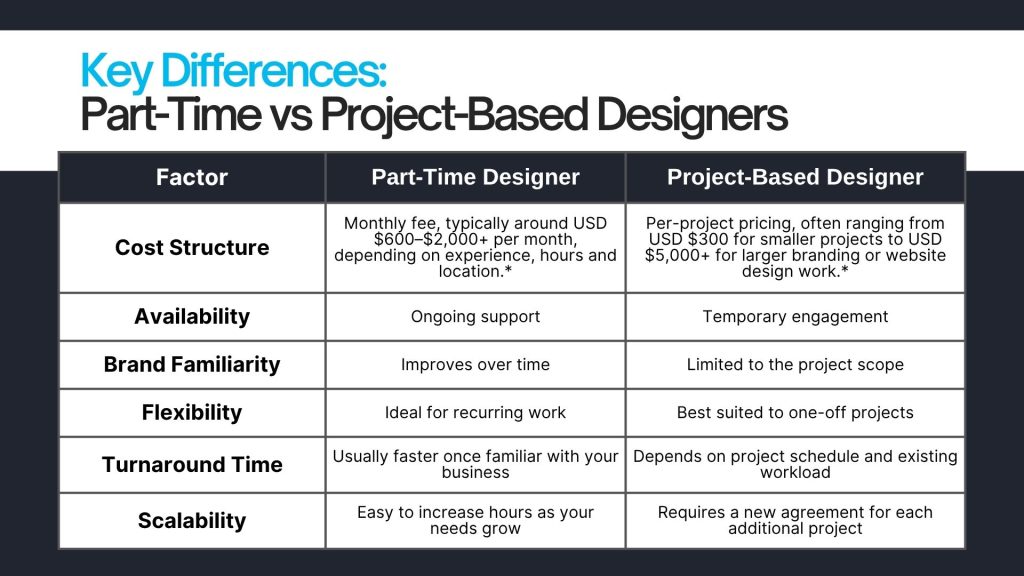
*Average pricing varies by region, designer experience and project complexity.
When a Part-Time Designer Makes More Sense
A part-time designer is often the better investment when design work forms part of your regular business operations.
This model suits businesses that:
- Publish content consistently across multiple marketing channels
- Run regular email marketing campaigns
- Produce sales materials every month
- Frequently update websites or landing pages
- Value strong brand consistency across every customer touchpoint
Imagine a growing business that publishes weekly social media content, sends monthly email campaigns and regularly creates promotional graphics. Hiring a different designer for every request would require repeated briefings, inconsistent design styles and additional administrative effort.
With an ongoing designer, those processes become far more streamlined. They already understand your brand, know your preferred style and can respond quickly to new requests.
When a Project-Based Designer Is the Better Choice
Not every business requires continuous design support. If your design needs revolve around a single initiative with a clearly defined scope, a project-based designer often provides the most cost-effective solution.
This option works well for:
- One-time branding projects
- Website redesigns
- Product launches
- Trade shows and exhibitions
- Marketing campaigns with fixed timelines
For example, if you’re preparing to launch a new website and need a complete set of design assets, hiring a project-based designer allows you to complete the work without committing to an ongoing monthly arrangement.
Which Option Delivers Better Long-Term Value?
The answer largely depends on how frequently your business needs design support.
A project-based designer may appear less expensive initially if you only require occasional work. However, businesses that commission new design projects every month often find that individual project fees add up quickly over six to twelve months.
An ongoing designer also delivers value beyond direct cost savings.
They spend less time learning your business, require fewer revisions and maintain visual consistency across every piece of content they produce. As that familiarity grows, productivity naturally improves. Instead of explaining your brand from scratch with every new request, you can focus on moving projects forward.
If your business regularly creates marketing assets, it often makes financial and operational sense to outsource graphic designer support through a dedicated part-time arrangement rather than repeatedly commissioning individual projects.
Why Many Growing Businesses Choose Dedicated Offshore Designers
Many businesses now look beyond local hiring to build flexible creative teams. Offshore designers provide access to experienced professionals while helping businesses manage operating costs and scale more efficiently.
A dedicated offshore designer offers several practical advantages:
- Predictable monthly costs that simplify budgeting
- Consistent creative support throughout the year
- Stronger collaboration through an ongoing working relationship
- Greater flexibility as your workload increases
Businesses frequently outsource design functions to access skilled talent while maintaining lower operating costs and the flexibility to grow without expanding their in-house teams.
At All In Outsourcing, businesses can find experienced offshore graphic designers who support both part-time and project-based requirements. Whether you need someone to handle recurring marketing assets or deliver a specific creative project, the focus remains the same: connecting you with talented professionals who integrate seamlessly into your workflow and provide reliable, high-quality design support as your business evolves.
Conclusion
Both outsourcing models offer genuine advantages, but they solve different business challenges.
Project-based designers are ideal for clearly defined, one-off initiatives with a fixed timeline. Part-time designers, on the other hand, provide ongoing creative support, stronger brand consistency and greater long-term value for businesses with recurring design needs.
Before making a decision, consider how often your business requires design work, how quickly projects need to move and where your business is headed over the next year. If your creative workload continues to grow, choosing to outsource graphic designer services can provide the consistency, flexibility and scalability needed to support that growth with confidence.
Partner with All In Outsourcing to find experienced offshore designers who deliver consistent, high-quality creative support, without the overheads of hiring in-house.